Tunisia's recent award of 309 solar projects totaling 455 MW under the sixth authorization round represents more than a capacity addition. It demonstrates a deliberate strategy to accelerate renewable energy deployment through a large number of projects sized below 10 MW, including several at the 10 MW threshold. According to the Ministry of Industry, Mines and Energy, the selected projects collectively amount to 455 MW across 309 developments.
While large utility-scale solar facilities often dominate discussions about the energy transition, portfolios composed of smaller projects offer unique advantages that are particularly relevant to Tunisia's energy challenges and development objectives.
Faster Deployment, Faster Impact
Projects in the 1 MW to 10 MW range are generally easier to permit, finance, interconnect, and construct than large utility-scale facilities. This means new renewable capacity can be brought online more quickly, helping address Tunisia's growing electricity demand and reducing dependence on imported fossil fuels.
Rather than waiting for a handful of very large projects to reach completion, a distributed portfolio allows renewable energy capacity to be added progressively across the country, delivering benefits sooner and reducing implementation risk.
Supporting Local and Regional Development
Medium-scale solar projects create opportunities for broader participation by local developers, investors, engineering firms, contractors, and communities. The economic benefits are distributed across multiple regions rather than concentrated in a few large sites.
This approach encourages the development of local expertise, strengthens Tunisia's renewable energy supply chain, and creates jobs throughout the project lifecycle, from development and permitting to construction and operations.
Reducing Grid Constraints
One of the most compelling advantages of projects below 10 MW is their ability to connect closer to electricity demand centers. Distributed renewable generation can reduce transmission losses, improve network efficiency, and lessen the need for costly transmission upgrades.
For Tunisia, where grid infrastructure expansion requires significant investment, strategically located medium-scale solar projects can help optimize existing networks while increasing renewable energy penetration.
Building a More Resilient Energy System
A portfolio of hundreds of geographically dispersed projects inherently improves energy system resilience. Dependence on a small number of large generating facilities is reduced, and renewable generation is spread across different climatic and geographic regions.
This diversified approach can enhance reliability while reducing exposure to localized outages or infrastructure constraints.
An Essential Complement to Utility-Scale Solar
The importance of this authorization round should not be viewed in isolation. Tunisia's long-term renewable energy ambitions will require both large utility-scale projects and a substantial number of distributed solar installations.
Utility-scale facilities will continue to deliver large blocks of low-cost renewable electricity and remain essential for meeting national renewable energy targets. However, medium-scale projects provide flexibility, geographic diversity, faster deployment, and local economic benefits that large projects alone cannot fully achieve.
In that sense, the 455 MW awarded in this round represents a vital middle layer between distributed rooftop generation and large utility-scale solar parks.
A Model for Achieving Tunisia's Energy Goals
Tunisia's energy transition is ultimately about more than installed megawatts. It is about increasing energy independence, reducing fuel imports, enhancing grid resilience, stimulating economic development, and lowering carbon emissions.
By awarding 455 MW across 309 projects, Tunisia is signaling that achieving these goals will require participation from many stakeholders and deployment across many locations.
The significance of this program therefore lies not only in its total capacity, but also in its structure. Hundreds of projects under 10 MW can create a resilient and diversified renewable energy ecosystem that complements future utility-scale developments and helps move Tunisia closer to its long-term vision of a secure, sustainable, and domestically powered energy future.
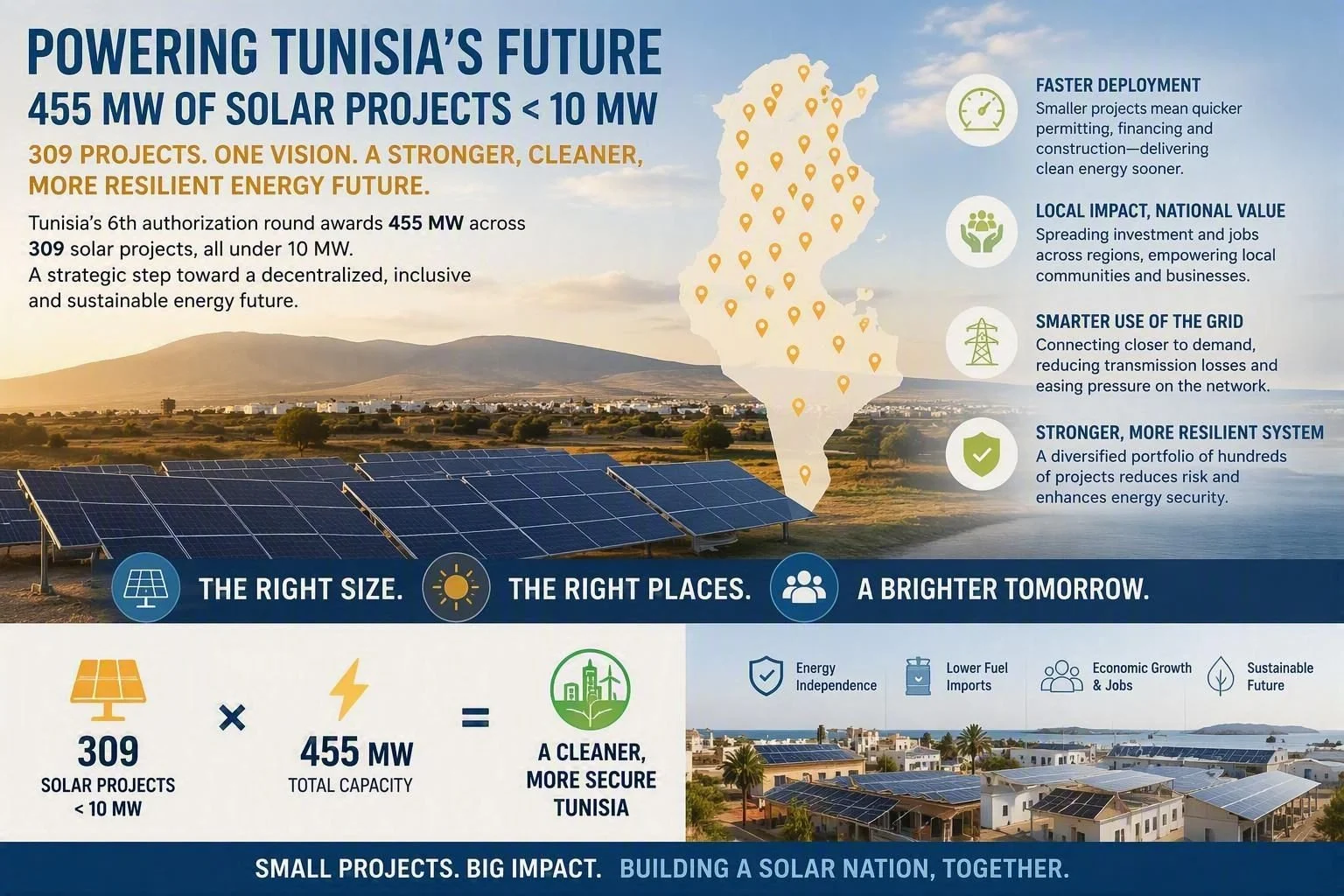
Small Projects. Big Impact.